
Erasmus+ Student Mobility
Erasmus+ Student Mobility
Outgoing Student – Study Mobility
Outgoing Student – Traineeship Mobility
Study Mobility
Student study mobility takes place within the framework of the Erasmus Charter for Higher Education (ECHE) and the existing inter-institutional agreements of the higher education institution. It involves a student enrolled at a higher education institution completing part of their studies at a partner higher education institution abroad under an inter-institutional agreement. The duration of the activity may range from 2 to 12 months for each study cycle (one, two, or, depending on the system in some countries, three semesters). Study cycles refer to associate/bachelor’s, master’s, and doctoral levels. Students are expected to take a course load of at least 30 ECTS credits per semester during the mobility period.
For applications to be assessed under study mobility, an inter-institutional agreement must exist between the relevant department and the institution the student wishes to attend. Therefore, applications from departments without an inter-institutional agreement will not be considered under study mobility. However, students from departments without such agreements may apply for Erasmus+ traineeship mobility.
Bilateral Agreements
Information about our bilateral agreements is provided below.
Traineeship Mobility
Traineeship mobility enables a student enrolled at a higher education institution to undertake a traineeship related to their academic field at a company, research institute, laboratory, or other institution or organisation abroad. Attending courses at a higher education institution is not considered a traineeship. The activity lasts between 2 and 12 months for each study cycle. Traineeships may take place during any year of the student’s studies. In addition, students in the final year of their study programme may undertake a traineeship within 12 months after graduation.
For a post-graduation traineeship, the application must be submitted before the student graduates, while they are still enrolled in an associate, bachelor’s, master’s, or doctoral programme. Graduates may not apply after graduation. The post-graduation traineeship must be completed within 12 months of the graduation date. For recent graduates who are conscripted to complete military service during this period, the duration of military service is added to the maximum 12-month period. The combined duration of the post-graduation traineeship and any mobility undertaken by the student during the same study cycle must not exceed 12 months.
Examples of Eligible Traineeship Hosts
A public- or private-sector organisation established in a country where traineeship activities may take place can serve as a host, provided it operates in the labour market or in the fields of education, training, youth, research, or development. The following is a non-exhaustive list of examples of eligible host organisations:
Small, medium-sized, or large public- or private-sector enterprises
Local, regional, or national public bodies
Embassies or consulates of the sending country abroad
Business organisations or associations, such as chambers of commerce, trade and craft associations, stock exchanges, and trade unions
Research institutes
Foundations
Schools, institutes, or educational centres (including vocational and adult education, and institutions ranging from pre-primary to secondary education)
Non-profit organisations, associations, and non-governmental organisations (NGOs)
Organisations providing career planning, professional consultancy, and information services
Higher education institutions. Higher education institutions in third countries associated with the Programme must hold an ECHE. Higher education institutions in third countries not associated with the Programme must be recognised by a competent authority under their national legislation and must have signed a bilateral inter-institutional agreement with the sending institution before the traineeship begins.
The following organisations are not eligible to host higher education traineeships under Erasmus+:
Institutions of the European Union and EU agencies (see https://europa.eu/european-union/abouteu/institutions-bodies_en)
National Agencies and similar organisations implementing EU programmes.
The relevant faculty/department authorities are responsible for assessing whether the traineeship host and traineeship programme are appropriate for the content of the student’s degree programme.
Minimum Requirements
To participate in the activity, students must first meet the following minimum requirements:
The student must be enrolled full-time in a higher education programme at a higher education institution at any of the first, second, or third study cycles.
a) First-cycle students must have a cumulative grade point average of at least 2.20/4.00.
b) For students whose transcripts are not yet available at the time of application: (1) students transferring from an associate degree must have an associate degree graduation GPA of at least 2.20/4.00; (2) preparatory-year and first-year students must have a high school graduation grade of at least 75/100.
c) Second- and third-cycle students must have a cumulative grade point average of at least 2.50/4.00.
For study mobility, students must have a sufficient number of courses or non-course ECTS credits available. For master’s and doctoral students who have no course load, for example those who have entered the thesis stage, a Learning Agreement may be prepared based on 30 ECTS credits of non-course workload for one academic semester.
If the student has previously participated in higher education mobility during the 2014–2020 and/or 2021–2027 Erasmus+ programme periods within the current study cycle, the total duration including the new activity must not exceed 12 months.
For institutions using a 100-point grading system, compliance with the minimum GPA requirement is determined using the corresponding grades in the grade conversion table prepared by the Council of Higher Education (YÖK).
If there is a high number of applications, higher education institutions may raise the minimum GPA threshold, provided that the criteria established by the National Agency are respected. However, the new threshold must not prevent the institution from receiving applications from at least twice the number of available places.
Selection Criteria
All procedures and transactions subject to evaluation will be carried out in accordance with the procedures and principles set out in the Application Handbook published by the Turkish National Agency for the relevant contract period.
Additional Grant Support
Additional grant support to be included in the amount of grant is available for the disadvantageous participants. To apply for the additional grant support, the disadvantageous participants must have fewer financial and social opportunities and meet the following conditions:
Being subject to Law no. 2828 (for whom there is a court ruling concerning protection, care or housing made by the Ministry of Family and Social Policy under Law no. 2828)
Students for whom protection, care or accommodation decision has been taken within the scope of Child Protection Law No. 5395.
Receiving orphan’s pension
Becoming a child of a veteran or martyr
Receiving survivor benefits (orphan’s pension or disability pension), or if one of the applicant’s family members (mother, father or guardian) receives survivor benefits, they are eligible to apply (The applicant must submit a document issued by some institutions such as the ministries, social assistance and solidarity foundations, Directorate General of Foundations, Turkish Red Crescent, AFAD (Disaster and Emergency Management Center) to prove that they are receiving survivor benefits at the time they apply for the mobility programme.)
Disabled Persons (Disabled persons with a disability rate of at least 70% documented by the Disability Health Board report in the "Regulation on Disability Assessment for Adults" published in the Official Gazette dated February 20, 2019 and numbered 30692)
Students whose parents or their guardians over the age of 65, who receive disability or needy pension within the scope of the Law No. 2022 dated 01.07.1976 on Pensions for Needy, Powerless and Orphan Turkish Citizens and Disabled and Needy Turkish Citizens.
Those who receive aid from AFAD for themselves or their first-degree relatives.
Those students who meet the above-mentioned conditions and provide documentary evidence can receive Additional Grant Support as described below, depending on the type of mobility
Erasmus+ Inclusion Support
The Erasmus+ Programme encourages the participation of people with special needs. A person with special needs is a potential participant whose personal physical, mental, or health condition would prevent them from taking part in a project or mobility activity without additional financial support.
Applications for Erasmus+ inclusion support must explain why the support is needed and include supporting documents. For example, if the request relates to a disability, a medical report containing information about the disability and its degree (issued no more than three months earlier) or a copy of a disability card must be provided. A medical report is required for chronic illnesses.
After the student has been selected, documents must also be added to the form confirming that the receiving higher education institution is aware that the incoming student/staff member requires inclusion support and undertakes to provide appropriate facilities.
The requested additional grant amount and the reasons for needing it must be explained in detail, as required by the form.
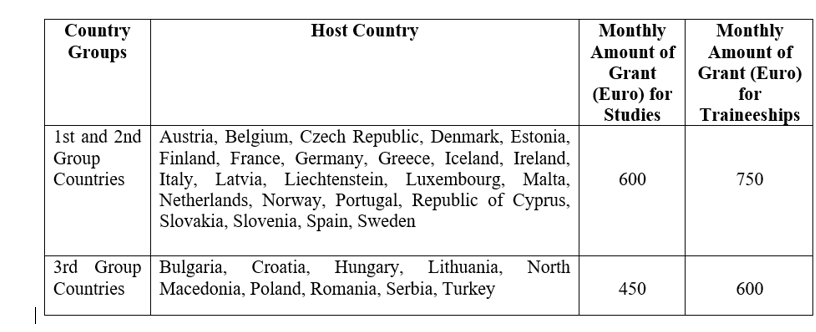
Monthly Grant Amounts for the 2026 Project
Grants are given to students to help them with additional expenses arising from being abroad during their activity. Grants are only a contribution, not intended to cover the full costs of the student's mobility.
Travel Support
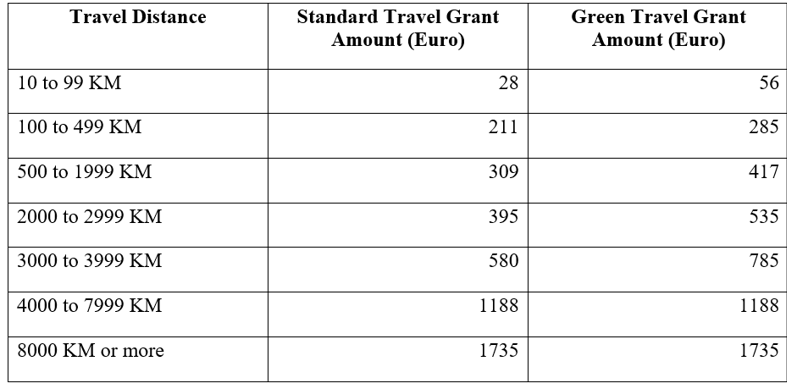
To contribute to students' travel expenses, the distance between the starting point of the mobility and the location where the activity will take place should be determined using the distance calculator provided by the European Commission. The travel grant should be calculated using the table below. The distance value obtained from the calculator corresponds to the round-trip grant amount in the table, and it should not be multiplied by two.
Green Travel Support
Green Travel Support refers to travel conducted using low-carbon emission public transportation methods such as buses, trains, and carpooling. To be eligible for Green Travel Support, participants must use green travel methods for both the outbound and return journeys, and more than half of the total travel distance must be completed using these environmentally friendly transportation options.
Here is a checklist for documents you must prepare before going, please submit all of them to the International Office at our Şile Campus:
BEFORE MOBILITY
- Copy of the Learning Agreement
- Copy of the Letter of Acceptance
- Copy of Yapı Kredi Euro Bank Account
- Copy of the Student Health Insurance policy covering the period of stay
- Işık University Tuition Fee Receipt (unless you are on a full scholarship)
- Student Learning Mobility Grant Agreement
DURING MOBILITY
- New Course Transfer Table
- Learning Agreement ( During Mobility)
AFTER MOBILITY
- Arrival - Departure Form original (You need to get approval in the attached document on the day you will leave the institution. You have already received approval for the Arrival part. When you leave the institution, please visit the International Office or send an e-mail to the International Office and get the approval signed and stamped by the Partner Institution for the Departure part).
- A copy of your signed Learning Agreement document. (If you have changed courses after your departure, a copy of the approved "During the Mobility" section of the Learning Agreement showing this change should also be submitted)
- Copy of the transcript (Please ask the Partner Institution to send the original by cargo if possible)
- Entry - Exit Certificate (You can get it via E-government)
- What to do after returning with the above documents,
- Your transcript and a new Course Transfer Table, this time including your course grades, completed in accordance with your last LA and Credit Transfer Table. Your Erasmus department coordinator will make your grade conversions according to your transcript, the signature of Selin Demir, one of the signatories in the document, will be taken by us)
- Online Survey (After you return and submit your documents above, you will receive an invitation via e-mail)
Outgoing Traineeship Mobility
WHERE CAN I TAKE AN INTERNSHIP?
Organizations that will host the internship; enterprises, training centres, research centers and other organizations that fit the definition of enterprise specified in the Erasmus + Program Guide. Countries where internships can be made; Germany, Austria, Belgium, Bulgaria, Czech Republic, Denmark, Estonia, Finland, France, Croatia, Netherlands, Ireland, Spain, Sweden, Italy, Iceland, Cyprus, Latvia, Liechtenstein, Lithuania, Luxembourg, Hungary, Macedonia, Malta, Norway, Poland, Portugal, Romania, Slovakia, Serbia, Slovenia, Greece.
In case the institution abroad where the internship will be carried out is a higher education institution, the study to be carried out is not an academic learning activity, but to gain practical work experience in the units for the general administration of the institution. Internship activities cannot be carried out for academic study purposes. Students who have a postgraduate education and are in the thesis period should apply to Learning Mobility for the studies that they will do in the presence of an advisor, which are in return for credit but not within the scope of internship. European Union institutions and EU agencies, the National Agency that carries out EU programs, etc. institutions are not eligible for higher education internship activity within the scope of Erasmus+.
HOW DO I FIND THE INTERNSHIP PLACE?
You can use Internship Search Databases in your internship search process;
- https://leonet.joeplus.org
- https://erasmusintern.org/
- https://ec.europa.eu/eures/public/opportunities
- https://www.wayup.com/
- https://www.internqueen.com/
- https://ec.europa.eu/eures/public/opportunities
- http://www.iagora.com/work/en/internships
- http://www.praxisnetwork.eu/
- https://graduateland.com/
- https://www.mediamonks.com/
- https://www.worldinternships.org/
- http://euconnect.org/
- https://www.monster.com/geo/siteselection
- https://tr.indeed.com/
2026-uygulama-el-kitabi-erasmus-ka131_0.pdf
erasmus-traineeship-mobility-orientation-presentation-for-the-2026-2027-academic-year.pdf
erasmus-study-mobility-orientation-presentation-for-the-2026-2027-academic-year.pdf